
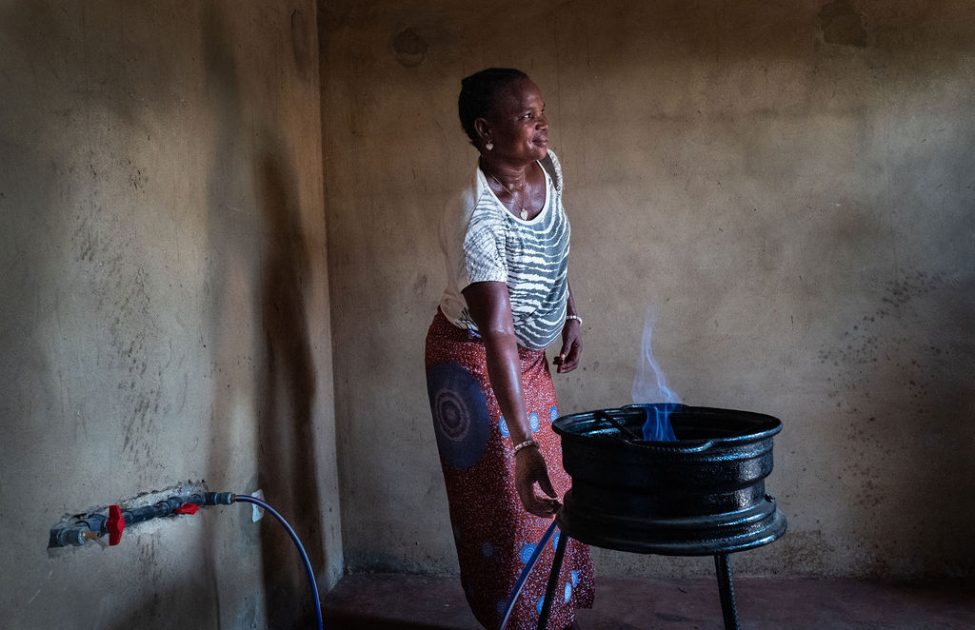
In Boukoumbé, a municipality in northern Benin, a cooperative of around twenty women meets regularly to process shea nuts into butter. This is an important activity for diversifying their income alongside farming and cattle breeding, but it is challenging and requires a great deal of energy. Furthermore, it is very time-consuming and requires large quantities of wood and water, which means that the process is not very profitable. Yet it is a natural fit for agriculture and cattle breeding: the women have been able to use animal manure as fertiliser for the fields… and now also as a source of energy.
Innovation to support female entrepreneurs in rural areas
The women’s cooperative has been using gas to heat its products for the shea butter processing. This marks a significant milestone: the inauguration of the very first biodigester installed by Vétérinaires Sans Frontières Belgium in Benin. Thanks to this system, biogas can be produced from organic material, particularly cow manure. That gas can then be used directly for heating.

©Loïc Delvaulx
Martine Ouyata, head of a cooperative that processes shea butter in Boukoumbé and mother of six children, tells her story:
“Processing shea requires a lot of wood. If we add up the costs of wood and water, it turns out to be quite expensive. We used to have to buy water, because there was no pump. The pump was installed last year. Processing shea requires a lot of water. We use three 25-litre jerrycans of water a day.
Wood also poses a problem in the processing of shea butter. Trees are cut down for combustion without any new ones being planted. We also buy wood and coal, which are becoming increasingly expensive. Heating over a wood fire is rather impractical, as we end up covered in soot and inhale the smoke. We go through four to six bags of wood a month. We used to carry the wood on our heads, now we have a tricycle to transport it.”
For activities such as the processing of shea or soya, this innovation makes a world of difference. Biogas replaces wood or coal, reducing the amount of water and fuel required and shortening the cooking time. As a result, women have more free time, greater comfort, a lower risk of respiratory conditions and better hygiene, as they are no longer covered in soot all the time.
How does a biodigester work?

© Loïc Delvaulx
A biodigester works on a simple principle: organic material, mostly cow manure and vegetable waste, is mixed with water and put into an underground tank. In Benin, the model used has a fixed dome. It has a vertical chimney roughly one metre high, into which the material is poured.
Inside, the material moves between two chambers. The fermentation happens in the first chamber, and the second chamber stores the digestate, which is the processed material. As a result of fermentation, gas is produced naturally and rises upwards due to the pressure. The gas is then collected and piped to the cooker, which is fitted with a tap. Through another opening, the women can easily access the liquid digestate. They share the digestate to fertilise their fields.

© Loïc Delvaulx
Timothée, project manager at our implementing partner CERD Benin, explains:
“Another advantage of biodigesters is that, after about two months of operation, they produce high-quality liquid manure. That manure is rich in minerals for crops. Therefore, less fertiliser is necessary and the agricultural production can be increased. In two months, you can harvest around 3 m³ of liquid manure, which is equivalent to 30 kg of fertiliser. Biodigesters also require a lot of maintenance. The sand that builds up needs to be removed and, in case of failure, professionals need to repair it. That is why ten people were trained to build and repair this structure.”
Moving towards more sustainable management of natural resources
In Benin, wood remains essential for many rural communities. However, the population’s awareness of the need to conserve forests is rising. In areas where there is no alternative, trees are still being felled. Pressure on natural resources is also increasing due to ongoing population growth, which contributes to alarming deforestation. Annual deforestation stands at around 2.4%, with a particularly high rate in the northern part of the country.
In response to this issue, Vétérinaires Sans Frontières, together with the support of the European Union, plans to build seventy biodigesters. Twenty of these biodigesters are intended for agricultural cooperatives. The very first biodigester is now fully operative.
Rural women: leaders of environmental restoration

©Loïc Delvaulx
Besides the technological aspect, people also learn about the conservation of natural resources at each biodigester installation. In Boukoumbé, the women were trained to plant and graft trees, contributing to reforesting the local area.
Martine and her colleagues are gradually becoming leaders of ecological change. Thanks to the energy their animals produce, they are reducing their environmental impact, improving their health and becoming more independent. This innovation bridges the gap between ecology, economy and empowerment.